Recurring event tickets in WordPress: selling one class, ten Tuesdays
1 Sep 2026 · Eventnetic Admin

A yoga studio runs the same class every Tuesday for ten weeks. Twelve mats a night. Somebody wants to book the Tuesday after next, one week, not the term.
That is harder to sell than it sounds, and most of the obvious answers either cost a fortune or cannot do it at all.
This is how to build it in WordPress. Still Point Studio is our demo: one room in east London, three classes a week, ten-week terms. Every screenshot below is that site running.
Why the obvious answers do not fit
The studio software route
Mindbody, Glofox, TeamUp and the rest are built exactly for this, and they work. They also cost like software built for chains.
| Platform | Entry price | A year |
|---|---|---|
| TeamUp | from £60 a month | £720 |
| Mindbody | from $79 a month, tiers at $139 and up | $948 to $1,668 |
| Glofox | around $110 a month | about $1,320 |
Be fair about what that buys: memberships, class packs, a branded phone app, marketing tools, staff rotas. A studio with four hundred members and three instructors needs most of it.
A studio with twelve mats and three classes a week does not, and is paying somewhere between £700 and £1,400 a year for a booking form.
The WordPress calendar route
So you look at a calendar plugin instead, and hit a wall its own documentation is upfront about:
For now, you cannot add standard tickets (i.e. for a specific date and time) to recurring events.
That is The Events Calendar, the most installed event plugin on WordPress. It handles repetition properly. It just cannot sell a ticket for one specific date of a repeating thing, which is the entire job here.
The offered alternative is a Series Pass covering every date in the run. For a ten-week course that is a real product. It is not a drop-in, and it has a second catch their documentation also states plainly:
Capacity and attendance is handled at the Series level, so when someone purchases a pass the availability is decreased everywhere.
Twelve mats. Sell one pass and you have eleven places on every Tuesday at once, including the six that person will never attend. The number in the system stops matching the mats on the floor.
The other way round it is to abandon recurrence and build ten separate events. That works, and now you maintain ten descriptions and nine extra edits every time anything changes.
What it costs to do it yourself
A licence is £99 a year. Card processing is Stripe's 2.9% + 30p, which every option above also charges in some form.
Against £720 at the cheapest studio platform, that is roughly £620 a year kept, for a studio whose whole term might gross £2,000.
Step 1: the room
Add a location under Business. Name, address, and a note front of house will actually use.
Still Point's reads: "Twelve mats. Come up the side stairs; the shop below closes at six." Every studio has a sentence like that, and every studio answers it by email four times a week.
Step 2: the class, and its ten Tuesdays
Here is the decision everything else rests on.
A class is one event. A Tuesday is a date.
Create the event once with the class name, the time and the twelve mats. Then open the Dates tab and add the term:
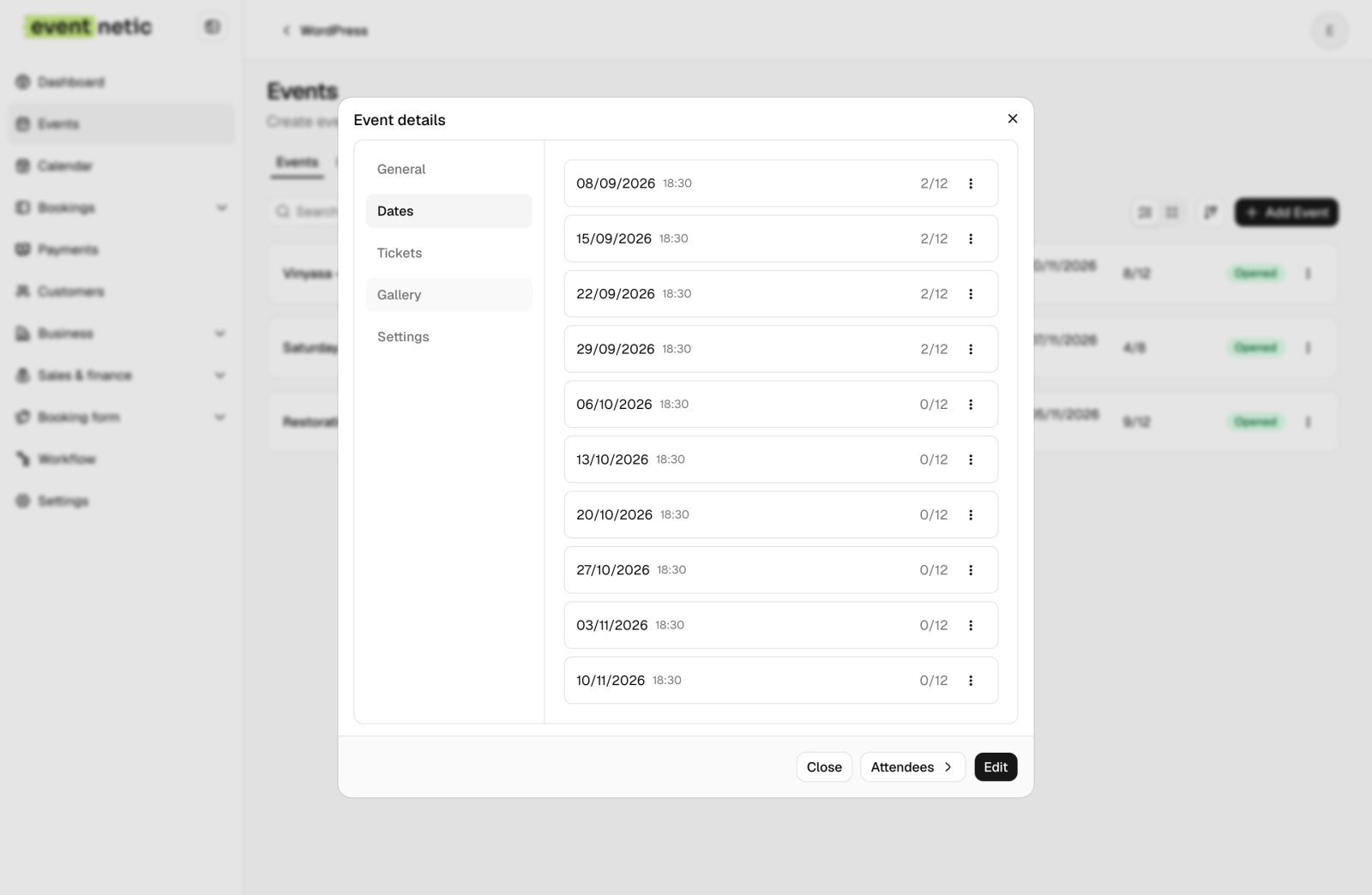
Look at the right-hand column. Every date carries its own number: 2/12 on the first four Tuesdays, 0/12 after that. Capacity belongs to the night, not to the class.
That is the whole thing. Selling out the 15th tells you nothing about the 22nd, and it is exactly what a series pass cannot express.
Dates are a list rather than a rule, which matters when the term meets a bank holiday. Untick that Tuesday. The other nine are untouched, and anybody already booked on it is on a list you can see, which is the part that matters at nine in the evening when you have to tell them.
Step 3: two prices for the same mat
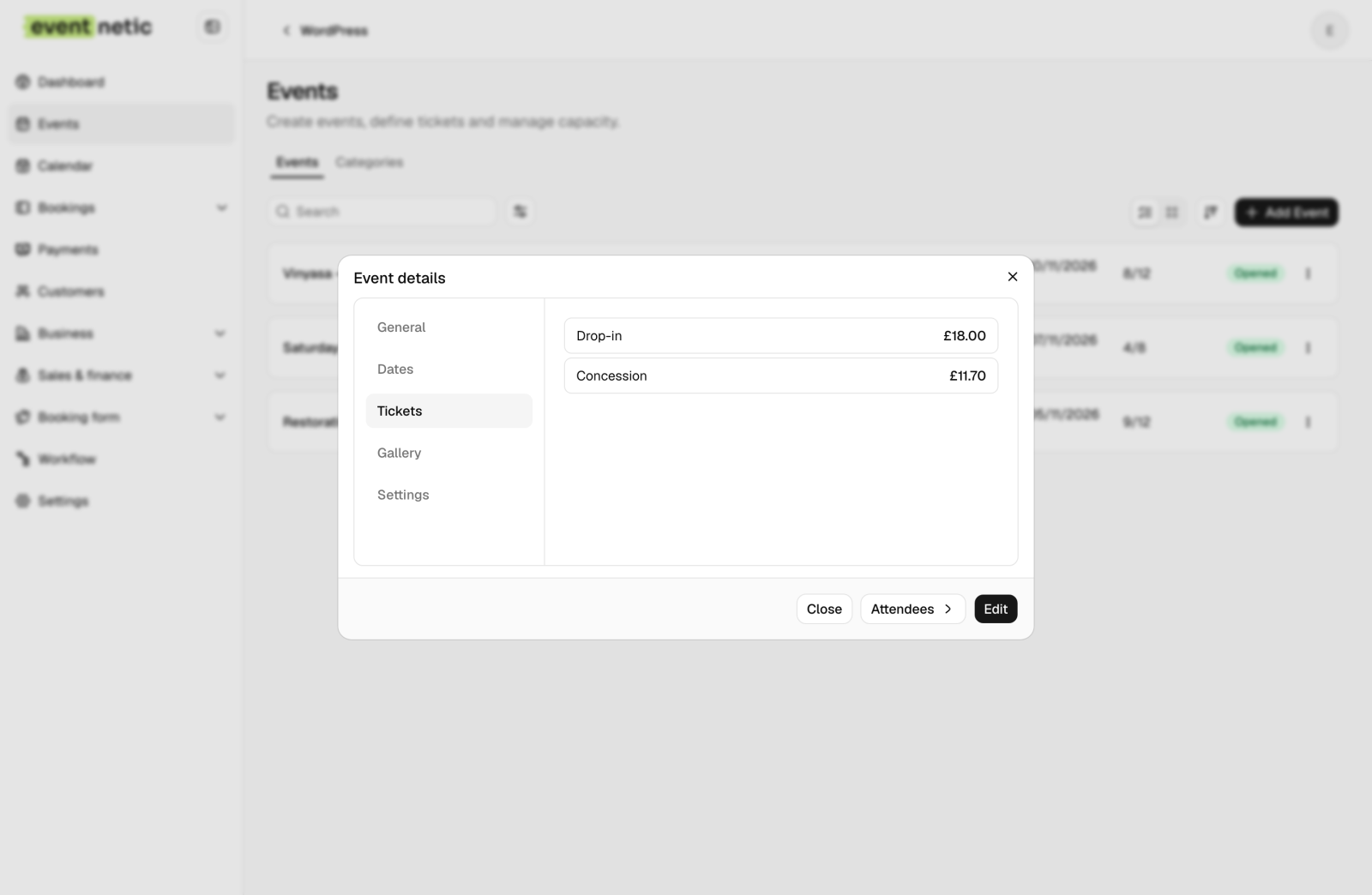
Drop-in at £18, concession at £11.70. Both are shared, meaning they draw from the same twelve places, because they are the same mat sold at two prices. A concession booking takes one of the twelve exactly like a full-price one.
Write them once, on the event, and they apply to all ten Tuesdays. Change the concession price in week three and it changes for the rest of the term, in one edit rather than nine.
Step 4: put it on a page
Each class gets a WordPress page with the booking block on it. This is what somebody booking a single Tuesday sees:

Ten dates, pick one, pick a ticket, pay. The checkout runs on your own site, so nobody is handed to a third party to finish, and the email address is yours.
Step 5: the rest of the timetable
Repeat for each class. Still Point has three:
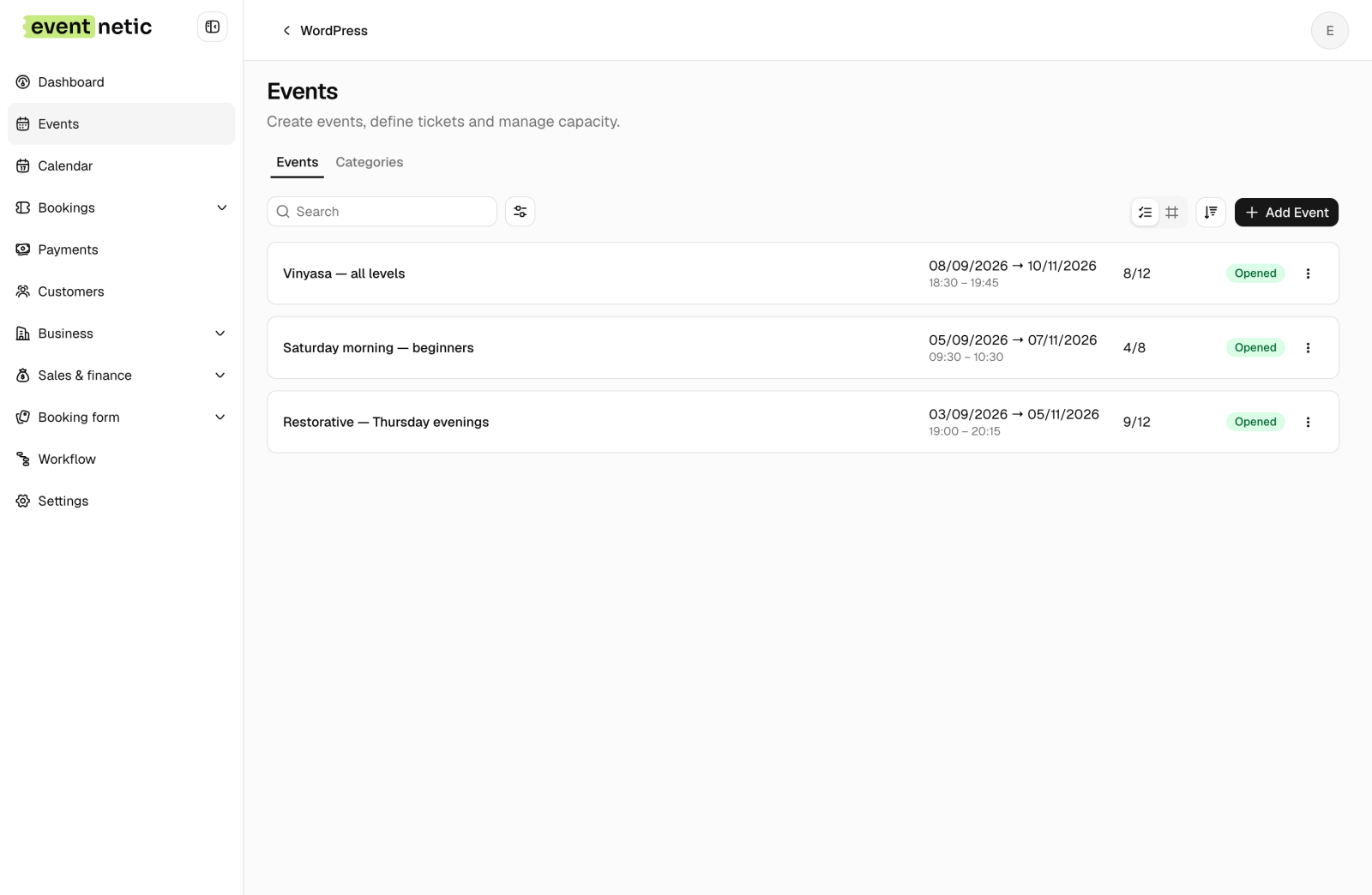
Notice the Saturday beginners' class holds eight rather than twelve. There is less room when people need correcting, and capacity is per event, so that is simply a different number on a different class.
Three events, thirty dates, three descriptions to maintain instead of thirty.
When a series pass is the better product
Sometimes the whole run is the thing. Take a ten-week beginners' course where week four makes no sense without week three. That should be sold as a course, and then a pass covering every date is the right product. Per-date selling just adds a step for the buyer.
The test is whether your dates are interchangeable. A drop-in class, a nightly film, a daily tour: interchangeable, sell by the date. A course, a conference, a festival weekend: not interchangeable, sell the whole thing.
We do not sell one ticket that admits you to every date. If that is your business, the plugins that do are the better tool and you should use them.
What we do not do
Worth saying before you commit a term to this.
No memberships and no class packs. A studio selling "ten classes for £150" or "£60 a month, come to anything" cannot express that here. Every booking is a ticket for a date. This is the single biggest reason a busy studio would still choose Mindbody or TeamUp, and it is a fair reason.
Repeating dates are paid. The free plugin gives an event one date. That is a real limit, not a nudge. There is no event limit, no booking limit and no time limit, but a ten-week term needs a licence.
So this is not a free-versus-paid argument. Every option here charges for repetition. The difference is what the money buys: dates that cannot carry a ticket of their own, or dates that can.
Go and book a Tuesday
Still Point Studio is live with three classes, thirty dates and a term's bookings already in it.
Open the yoga demo and book one Tuesday, then look at the admin and watch that night's count move while the other nine sit still. Or start with the free plugin if a single date is all you need for now.
Every screenshot is the running demo, not a mock-up. The Events Calendar limitations are quoted from its own recurring-events and Series Passes documentation. Studio platform prices are entry tiers published by each vendor, checked on 2 September 2026; all vary by region and by what you switch on.


