
Most people quote one Eventbrite fee. There are two, and together they take about 13.8% of a sold-out night at $25 a ticket.
The second is easy to miss because it is charged on a different thing. This post works the arithmetic out on a real room, shows what the same night costs when you sell it yourself, and says plainly where Eventbrite is still the better answer.
On a paid ticket, Eventbrite charges organisers 3.7% + $1.79 as a service fee, per ticket, and then 2.9% as a payment processing fee, per order. Free events cost nothing, which is genuinely generous and worth saying. But the moment a ticket has a price on it, both fees apply.
The per-ticket $1.79 is the part that surprises people. It does not scale with your ticket price, which means it hurts most exactly where margins are thinnest.
What a 200-seat night at $25 costs on Eventbrite
Take a room that seats 200, a ticket at $25, and a night that sells out. That is $5,000 through the door.
| Line | Working | Cost |
|---|---|---|
| Service fee, percentage | 3.7% × $5,000 | $185.00 |
| Service fee, per ticket | $1.79 × 200 | $358.00 |
| Payment processing | 2.9% × $5,000 | $145.00 |
| Total | $688.00 |
That is 13.8% of the gate. On a $12 ticket the same arithmetic lands at 21%. That is a cinema seat, or a drop-in class. The fixed $1.79 is a much bigger share of $12 than it is of $25, and it does not care which.
You can pass the fees to the buyer instead of absorbing them. That does not make the money appear. It makes your $25 ticket cost about $28 at checkout, and the customer gets to decide whether that still feels like $25.
What selling from your own site costs instead
Selling from your own site is cheaper, but it is not free, and any comparison that pretends otherwise is selling you something.
You still need a payment processor. Stripe's standard rate is 2.9% + $0.30 per transaction. That is almost exactly what Eventbrite charges for processing, which makes sense. It is the same job. On the same $5,000 night that is $145 in percentage plus $60 in fixed fees: $205.
You also need software. Eventnetic Pro starts at $99 a year, and card payments sit on the paid side of that line. The free plugin takes bookings and handles payment at the door. For a box office selling to people standing in front of you, that is genuinely all you need. It is not a card checkout.
| The same sold-out night | Eventbrite | Your own site |
|---|---|---|
| Service fee | $543.00 | — |
| Card processing | $145.00 | $205.00 |
| Software, that night's share | — | see below |
| Taken off the top | $688.00 | $205.00 |
The difference is $483 on one night, against a licence that costs $99 for the year.
Where the break-even sits, per ticket
The honest way to put this is per ticket, not per night, because your room is not my room.
Eventbrite's service fee is the part you stop paying: 3.7% + $1.79. Against that you take on Stripe's $0.30 fixed fee, which Eventbrite's own processing charge does not itemise separately. So the saving per ticket is roughly 3.7% + $1.49.
- At a $10 ticket, you keep about $1.86 more per seat. A $99 licence pays for itself at 54 tickets.
- At a $25 ticket, about $2.42 per seat, and the licence is covered at 41 tickets.
- At a $60 conference pass, about $3.71, and you are level after 27.
For most venues that is one evening, or one weekend. After that the arithmetic runs entirely in your favour, and it keeps running every year without another fee per head.
There is a second-order effect worth knowing. Eventbrite's $1.79 is charged per ticket. Stripe's $0.30 is charged per transaction. So a family buying four seats is one Stripe fee and four Eventbrite fees. The more people book in groups, the wider the gap gets.
What Eventbrite gives you that your own site does not
This is where most comparisons quietly stop, so let us not.
Discovery. Eventbrite is a marketplace. People browse it looking for something to do on Saturday, and some of them will find you. Your own site has no such traffic and will not grow any by itself. If a meaningful share of your audience arrives through Eventbrite search, the fee is buying you customers, and that is a different conversation entirely.
Trust at the checkout. A stranger handing over a card recognises Eventbrite. They do not recognise you. That gap is real, and it closes slowly.
Nothing to run. No plugin to update, no payment keys to configure, no refund policy to write. If your event is annual and small, the fee may be cheaper than the hour it takes to set anything up.
If any of those three matter more to you than the money, stay where you are. The fee is not a scam. It is a price for a service, and for plenty of organisers it is a fair one.
When self-hosted ticketing is the better answer
The pattern is fairly consistent. Self-hosting wins when:
- Your audience already knows you. A theatre with a mailing list, a studio with regulars, a museum with a sign outside. You are not paying for discovery you do not need.
- You sell the same thing repeatedly. A weekly class, a nightly showing, a tour that runs every day. The per-ticket fee compounds fastest here, and selling the same event on many dates is where most plugins start to struggle anyway.
- Your tickets are cheap. The fixed $1.79 is a rounding error on a $200 pass and a serious tax on a $9 one.
- You want the customer list. On your own site the email address is yours, in your database, without a platform between you and the person who bought.
What self-hosted ticketing looks like, running
We keep five demo businesses running so this is not an abstract argument. A cinema, a theatre, a yoga studio, a conference and a museum. Each one has real dates, real ticket types and real bookings already in it. You can open the checkout and walk it end to end without giving us an email address.
The cinema is the clearest illustration of the arithmetic above: one screen, the same room sold four times a day, at prices where $1.79 a head would genuinely hurt. The theatre shows the other end of it, where seats are picked rather than counted.
Here is the part the fee is actually buying you away from. This is the last step of a checkout on the venue's own domain:
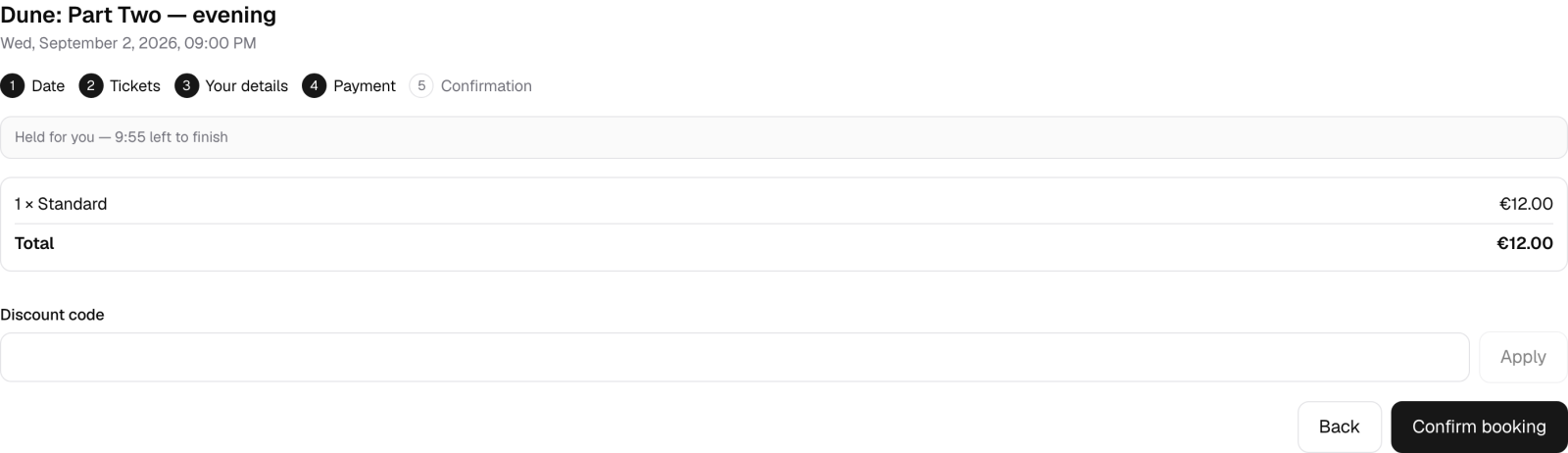
Nobody was sent anywhere to finish. The seats are held while they decide, and the money lands in the venue's own account rather than being paid out later minus a cut.
The other thing you keep is the list:
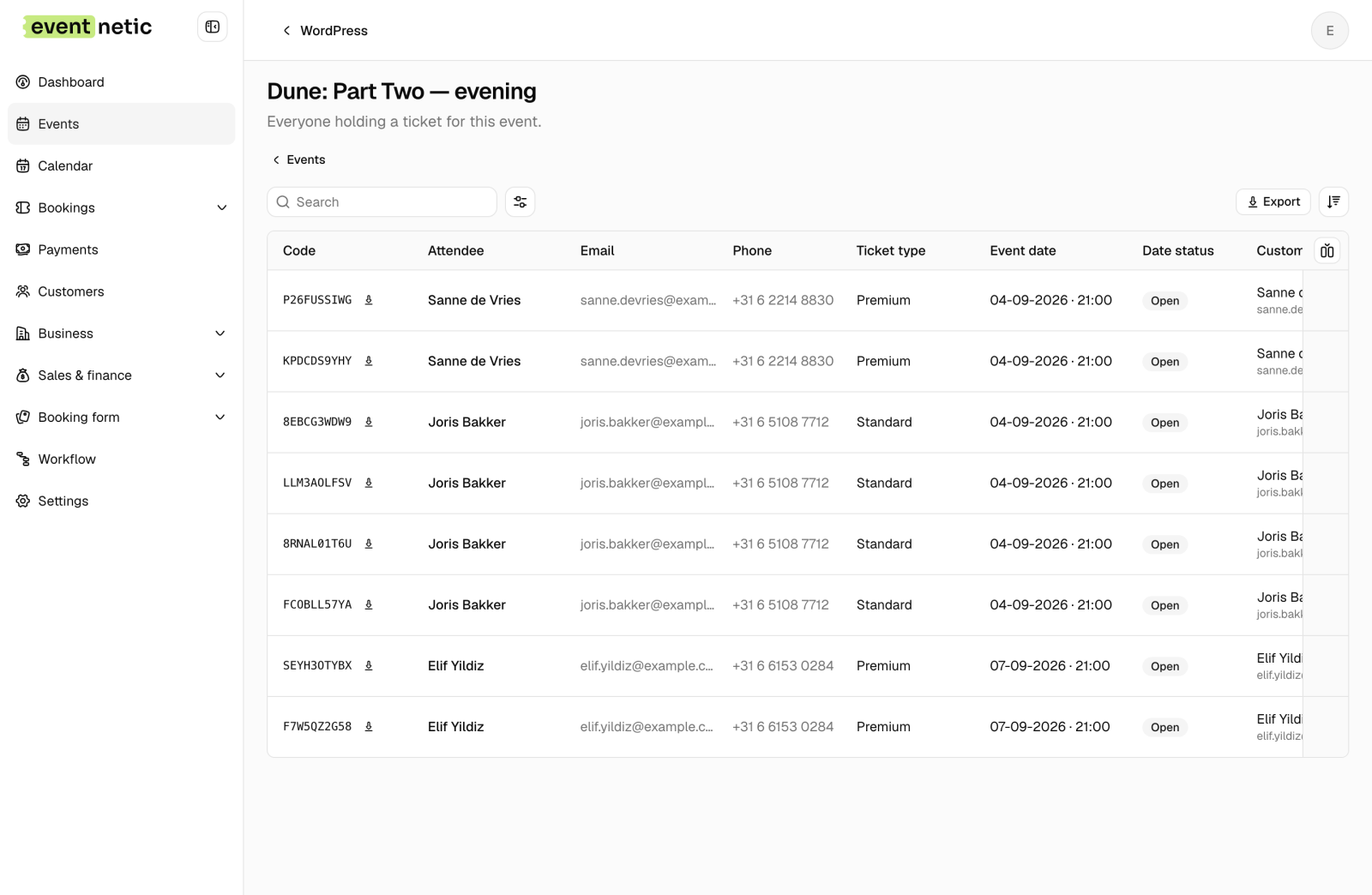
Every buyer, with their email address, in your database, exportable. On a marketplace that list belongs to the marketplace, and the next time you have something to sell you rent access to your own audience.
Open the demo and walk one through. Or download the free plugin, which has no event limit, no booking limit and no time limit, and see whether the checkout is one you would put your own name on.
Fees quoted from Eventbrite's published organiser pricing and Stripe's standard pricing, checked in September 2026. Both vary by country, so check your own before you plan around them.


