Timed entry ticketing in WordPress: eighteen people on a stair
2 Sep 2026 · Eventnetic Admin

The Wolfstoren has 137 steps and no lift. The stair is a spiral, wide enough for one person going up and one coming down, and the top is open to the sky.
Eighteen people fit on it at once. Not a round number somebody picked. Eighteen because a nineteenth turns a climb into a queue, and the guide can no longer be heard at the back.
Timed entry is selling that stair several times a day, every day, with each slot holding its own eighteen. This is how to build it in WordPress, with a screenshot of every step from our museum demo.
What timed entry costs on a ticketing platform
Three tours a day, thirty days, an average of twelve people on each. That is about 1,080 places a month, and at €15 an adult ticket it grosses €16,200.
Eventbrite charges organisers 3.7% + $1.79 per ticket, then 2.9% per order to process the card. On a €15 ticket that is €2.78.
| A month, 1,080 places at €15 | Platform | Your own site |
|---|---|---|
| Per ticket | €2.78 | €0.73 |
| Across the month | €3,002 | €794 |
| Share of the gate | 18.5% | 4.9% |
Roughly €2,200 a month, on a licence that costs €99 a year.
The fixed €1.79 is what does it. Museums sell cheap tickets in volume, which is the worst possible shape for a per-ticket fee. A conference charging €200 barely notices it. A tower charging €15 gives away a fifth of the gate.
Step 1: the gate
Add a location with the practical note attached. The Wolfstoren's reads:
Meet at the gate five minutes before. 137 steps, no lift, and the top is open to the sky.
Every museum has that sentence and answers it by email twenty times a week.
Step 2: one tour, its own eighteen, every day
A tour time is an event. A day is a date. So the 14:00 is one event with a list of dates, not thirty events.
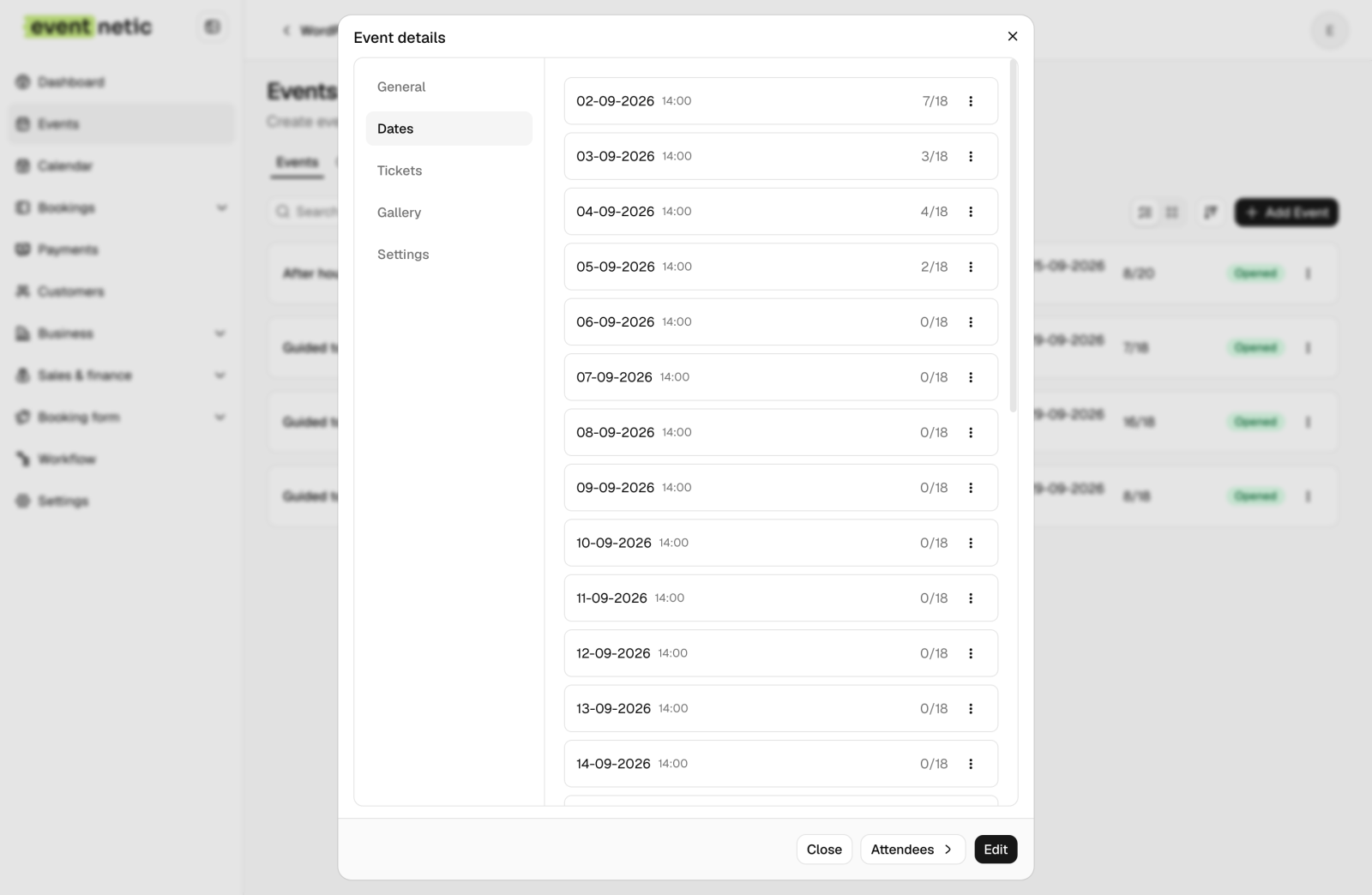
The number on the right of each row is the point. Every date carries its own count out of eighteen. Selling out Tuesday says nothing about Wednesday, and a busy Saturday does not close the run.
If capacity belonged to the event rather than the date, one full tour would shut the tower for a month. A museum would notice by lunchtime.
Step 3: one pool, three prices
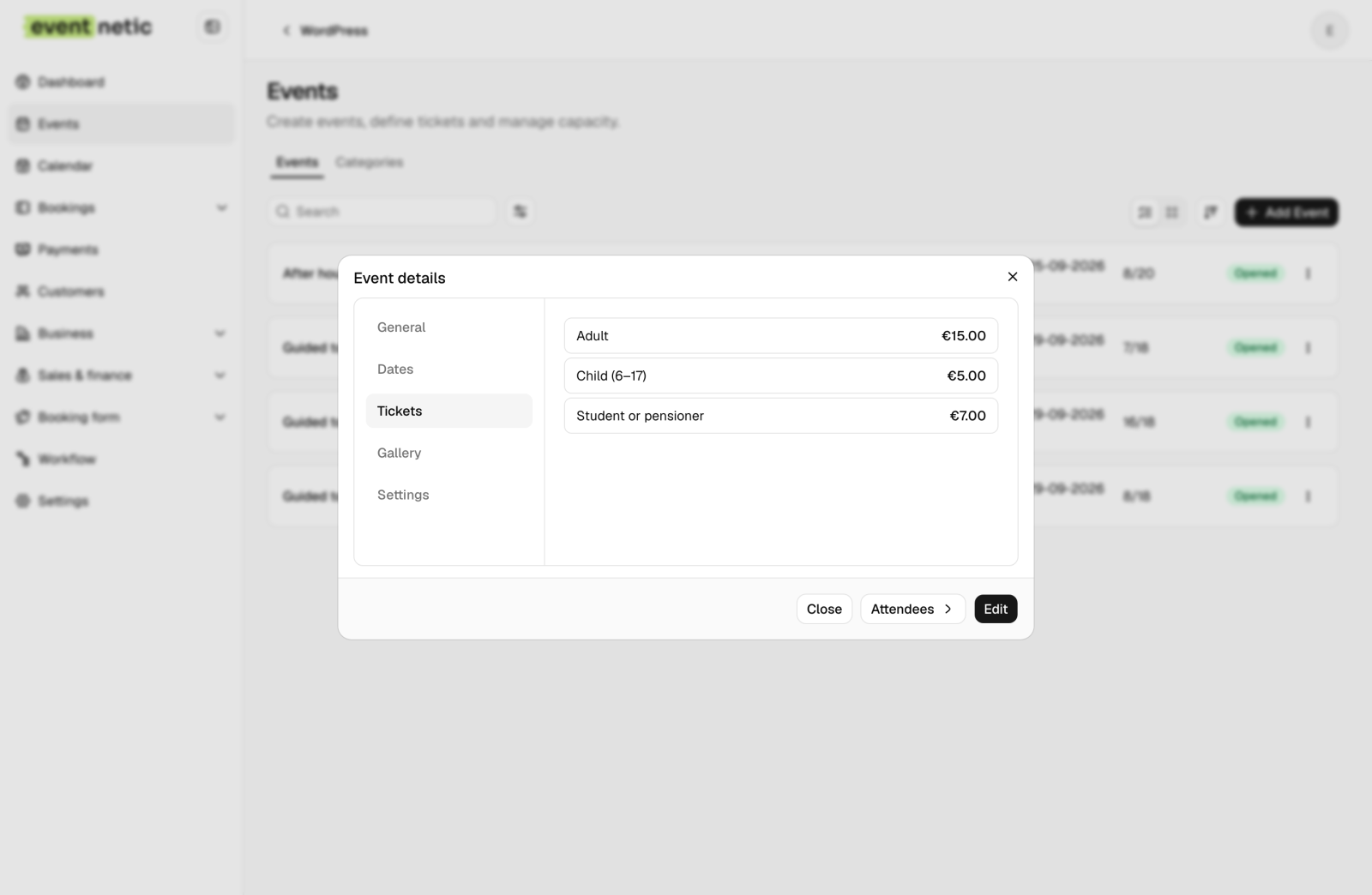
Adult €15, child €5, student or pensioner €7. All three are shared, which means they draw from the same eighteen places.
That is the modelling decision worth understanding. The stair does not care what somebody paid. Six adults and twelve children is eighteen people, and so is eighteen adults. The pool is the constraint; the ticket types only decide the price of standing in it.
Compare that with a theatre, where the stalls and the gallery are genuinely separate stock because they are separate rows of chairs. There you want per-ticket allocations. Here you want one pool. A model that only offers one of those two shapes will make you fake the other.
The per-order limits do different work. Six for adults and children, so a family is fine and a coach party has to ring. Four for concessions, because they are checked at the gate, and checking four cards is a moment while checking twelve is a queue.
Step 4: the free ticket that still takes a place
This one catches everybody, and it is the clearest example of capacity being physical rather than financial.
Small children get in free. They still take up a step. If a free child does not book a place, the tour that shows eighteen sold arrives at the gate with twenty-two people, and the guide turns a family away after they queued.
So the child ticket says:
Under sixes go free but still need a place booked. The stair is counted, not the ticket.
Whatever you use, make sure it can issue a zero-priced ticket that consumes a place. If free things are invisible to your capacity, your capacity is fiction.
Step 5: closing the door before the tour starts
Nobody books a tour starting in four minutes and reaches the gate. They will try, and then they will be angry, and it will be your fault for selling it.
Two settings do this, and both are on the event:
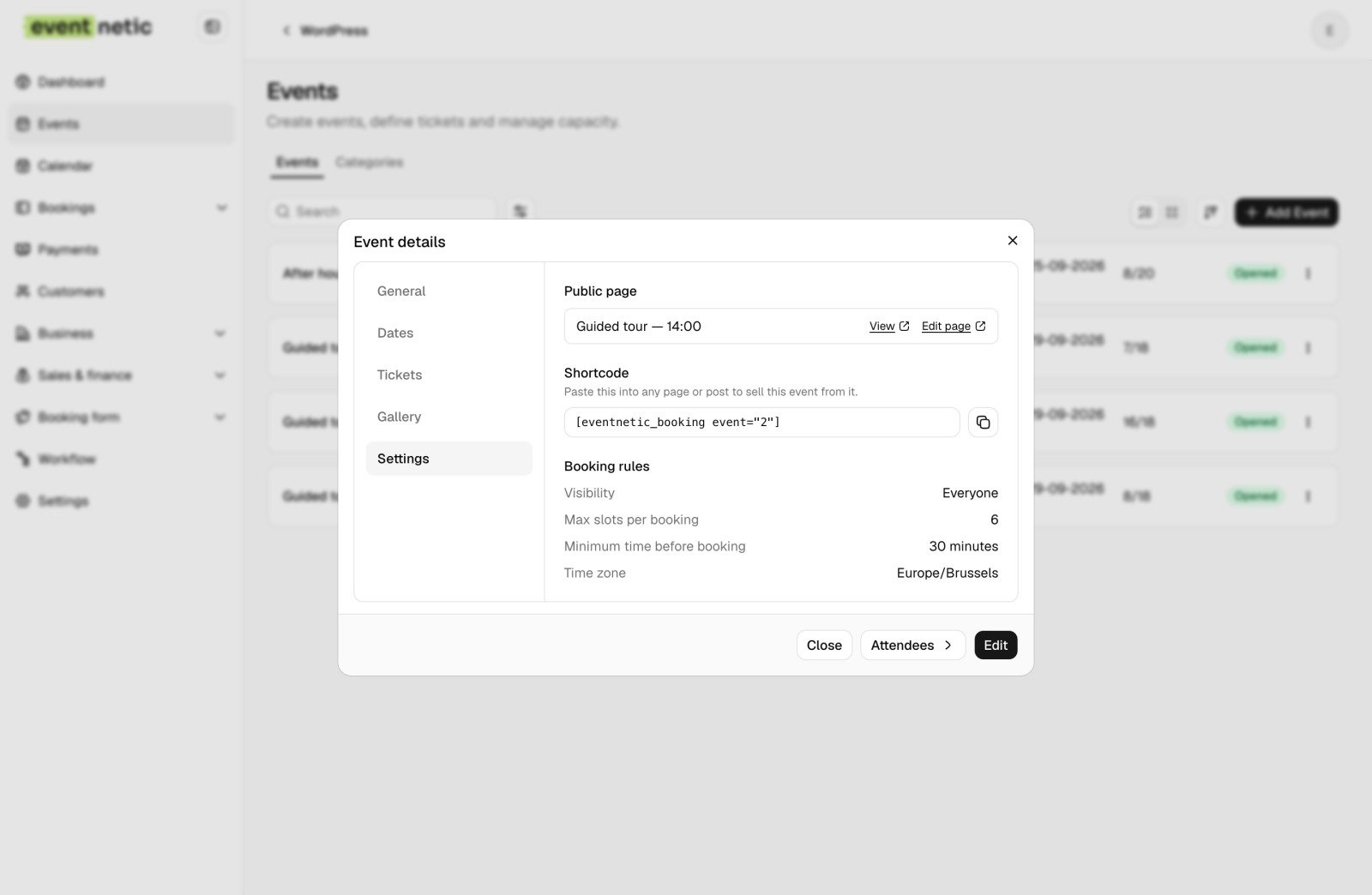
Minimum time before booking: 30 minutes. After that the website says booking has closed and sends people to the gate, where a human can look at the actual stair and decide.
Time zone: Europe/Brussels. The tower is in Ghent, so the cutoff happens in Ghent time, not on whichever host the site runs on and not in the visitor's. Somebody booking from Tokyo at what is 09:00 to them is buying a place at a specific moment in Belgium. Get this wrong and it is invisible until you move hosts, and then it is an hour out and nobody knows why.
One more thing that took getting wrong to learn: the cutoff counts from the date being booked, not from the event. An earlier version read the event's own start time, which meant a daily tour stopped selling the day after its first date, because every future date reported that the event had already begun. The rule has to be thirty minutes before this tour.
Step 6: put it on a page
The Settings tab also carries the shortcode, which is how a tour goes on any page or post:
Paste [eventnetic_booking event="2"] and publish. This is what a visitor gets:
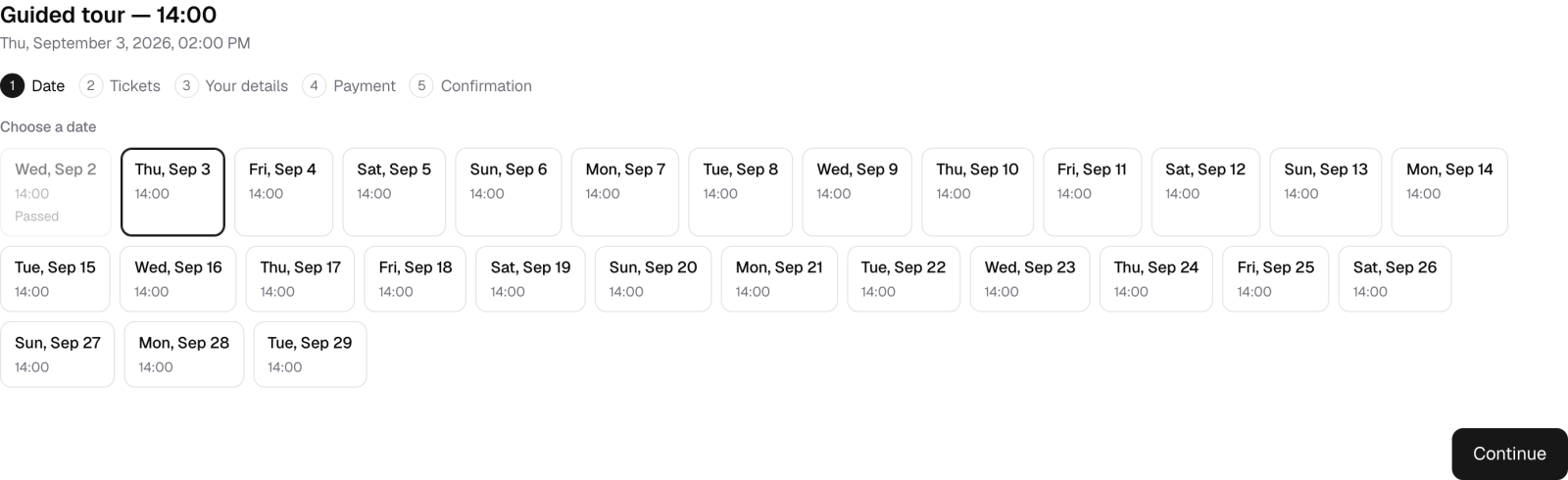
Step 7: the rest of the day
Repeat for each tour time. The Wolfstoren runs three, plus an evening event once a week:
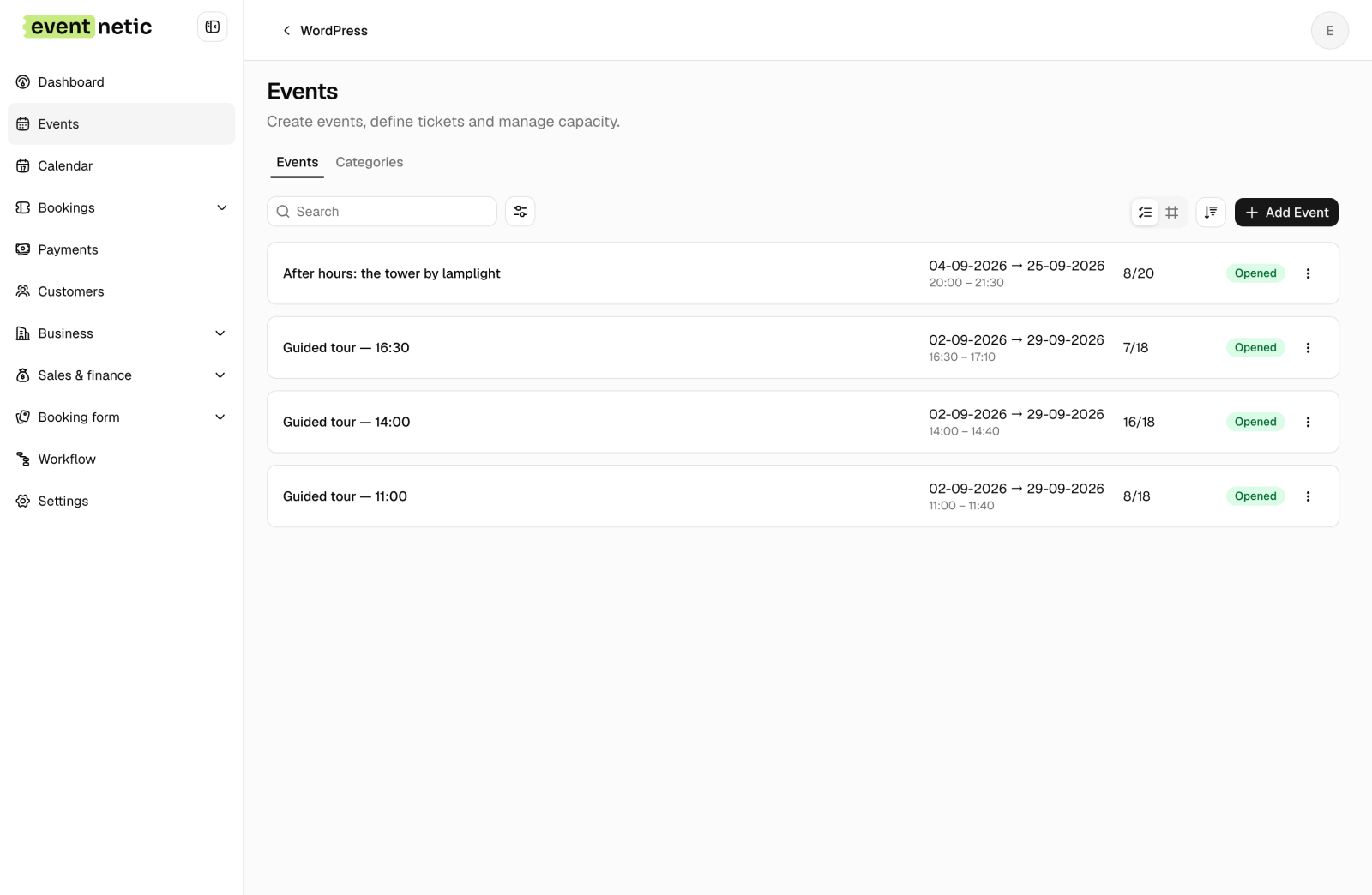
Look at the gaps between the tours. One ends at 11:40 and the next starts at 14:00. Eighteen people have to come back down the same stair the next eighteen are going up, and a guide who has done 137 steps twice needs lunch. Slot spacing is a decision about your staff and your stairs, not something software should guess.
The evening tour breaks the pattern on purpose: twenty places rather than eighteen, because nobody is climbing past anybody in the dark and the group stays together. One ticket type instead of three. Fridays only. Names collected for every attendee, which the day tours do not bother with.
What we cannot do yet
A family ticket that admits five people is not something Eventnetic can express, and I would rather say so here than have you find out on a Saturday.
Capacity is counted as attendees, and one ticket produces one attendee. A "family, two adults and three children" ticket sold as a single unit would occupy one place while five people climb. Our own museum demo had exactly that mistake in it until recently: eighteen places, plus two family tickets, and the tour could have arrived at twenty-eight people.
We removed it rather than leave a demo that oversold its own building. Visitors now pick two adults and three children, which is what the gate counts anyway. Package tickets that admit several people are written down as a real feature to build, not a thing to fake.
Timed entry across many dates is also a paid feature. The free plugin has no event limit, no booking limit and no time limit, but a tour that runs every day needs a licence.
Go and count the steps
The Wolfstoren demo is live with four weeks of tours, three a day, eighteen places each, and bookings already in it. One is unpaid on purpose so you can see how that looks in the admin.
Open the museum demo and book the 14:00. Then look at the same tour in the admin, where the count is the number of people rather than the number of orders.
Every screenshot is the running demo, not a mock-up. Tour times, prices and capacities are read from it. Platform fees are Eventbrite's published organiser rates and Stripe's standard pricing, checked on 2 September 2026; both vary by country.


