Walking tour booking in WordPress: a business with no building
2 Sep 2026 · Eventnetic Admin

A walking tour has no building.
No room, no seats, no door to count people through. The capacity is however many people can hear one guide outdoors next to a main road. The address is not an address, it is a place to stand. And on a wet Thursday somebody has to decide by hand whether it runs.
That makes it the least venue-shaped business on this blog, and the setup is different because of it. Ghost Signs Walks is our demo: fifteen places, two walks a day, a meeting point rather than a postcode, and children who pay nothing and still take a place. Every screenshot is that site running.
We should say up front that the money argument in this post is weaker than in the others. We ran the numbers before writing and they came out closer than we expected. That section is still here, with the real figures in it.
What it costs to sell a walk through somebody else
There are two separate costs and they get muddled together constantly.
The first is the OTA. Viator and GetYourGuide are where somebody standing in Manchester with an afternoon free actually finds you, and their commission is by far the largest line in a tour operator's accounts. Neither publishes a rate card. We looked, their supplier pages would not open for us, and the numbers you find quoted are on marketing blogs run by people selling something. We are not going to print a percentage we cannot trace to the company charging it.
The second cost is the software that runs your own bookings, and that one is published. Here are the two names a walking tour will actually be shown.
Bókun, which is owned by Tripadvisor, charges $49 a month plus 1.5% on its START plan, rising to $149 a month plus 1.25%. Bookings that come through Viator carry no Bókun fee at all. Rezdy charges $49 a month plus 3% per online booking on Foundation, and the 3% holds on every plan above it.
Now put a real season through that. Ghost Signs runs daily from April to October, plus golden-hour walks on Fridays and Saturdays, so call it 270 walks. Average seven of the fifteen places, at an average £13 once the concessions and the free children are mixed in. That is 1,890 places sold and £24,570 for the year, across roughly 756 orders.
| A £24,570 season | Subscription | Per booking | Total | Share |
|---|---|---|---|---|
| Rezdy Foundation | £436 | £737 | £1,173 | 4.8% |
| Bókun START | £436 | £369 | £805 | 3.3% |
| Your own site | £99 licence | £520 Stripe | £619 | 2.5% |
Against Bókun that is £186 a year. Real money for a business this size, and nowhere near the arguments in our other posts. Against Rezdy it is £554, which is closer to worth arguing about.
The subscriptions are converted from dollars at 0.7415, which is where the rate sat when we wrote this. It moves.
The more interesting difference is not the size, it is the shape. A walking tour in Manchester earns nothing between November and March. A subscription is charged in January anyway. £436 a year is 28 adult tickets you sell before the software has paid for itself, and five of those months you are not selling any.
What Bókun gives you for the difference is the thing we do not do at all: it plugs your availability straight into Viator and the rest of the OTA network. If most of your bookings arrive that way, that connection is the product, the £186 is not the question, and you should use Bókun. We would say the same to anyone who asked us.
Step 1: the location is a meeting point
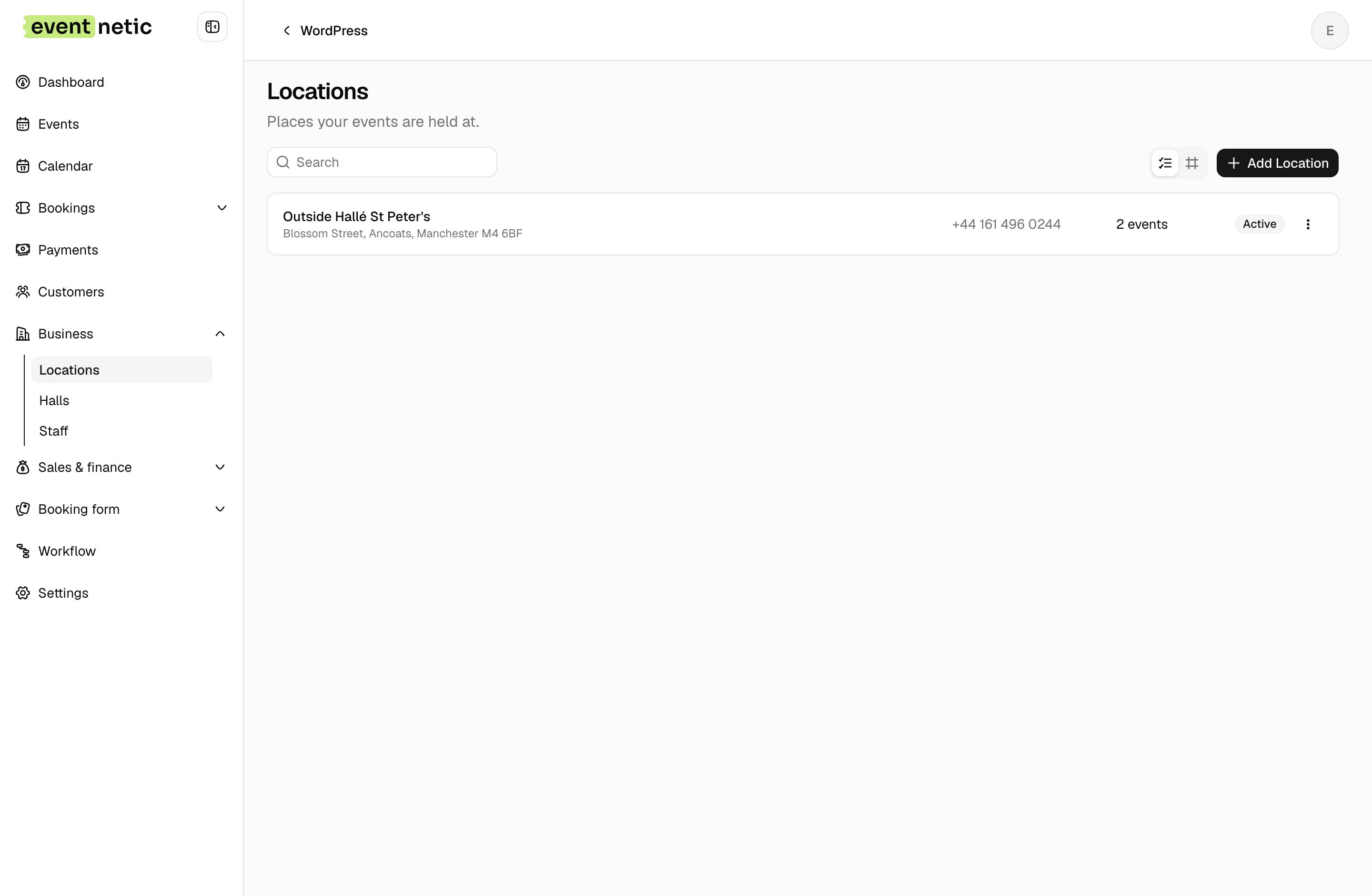
Read the name of that location. It is not "Hallé St Peter's". It is Outside Hallé St Peter's, because inside is a concert hall and your group is standing on the pavement.
Nobody has ever found a walking tour from a postcode. They find it from the thing they can see across the road. So the address field carries M4 6BF for the map app. The name and the note carry what a person actually needs. We stand under the arch by the church door, not inside. Look for a green umbrella.
That note also does the job a venue page would do for a theatre. Ninety minutes. All outdoors. One steep set of steps. Somebody with a knee decides from that sentence whether to book, which is better for both of you than finding out at step forty.
Step 2: fifteen, and where fifteen comes from
Fifteen is not a round number somebody liked. It is how many people can hear an unamplified voice outdoors on a street with traffic on it.
Push it to twenty five and the back six hear nothing, review you accordingly, and are right. This is the rare case where capacity is set by physics rather than by furniture or a fire officer. Write the reason down somewhere. Otherwise the person covering for you in August quietly raises it.
Step 3: three prices, one pool
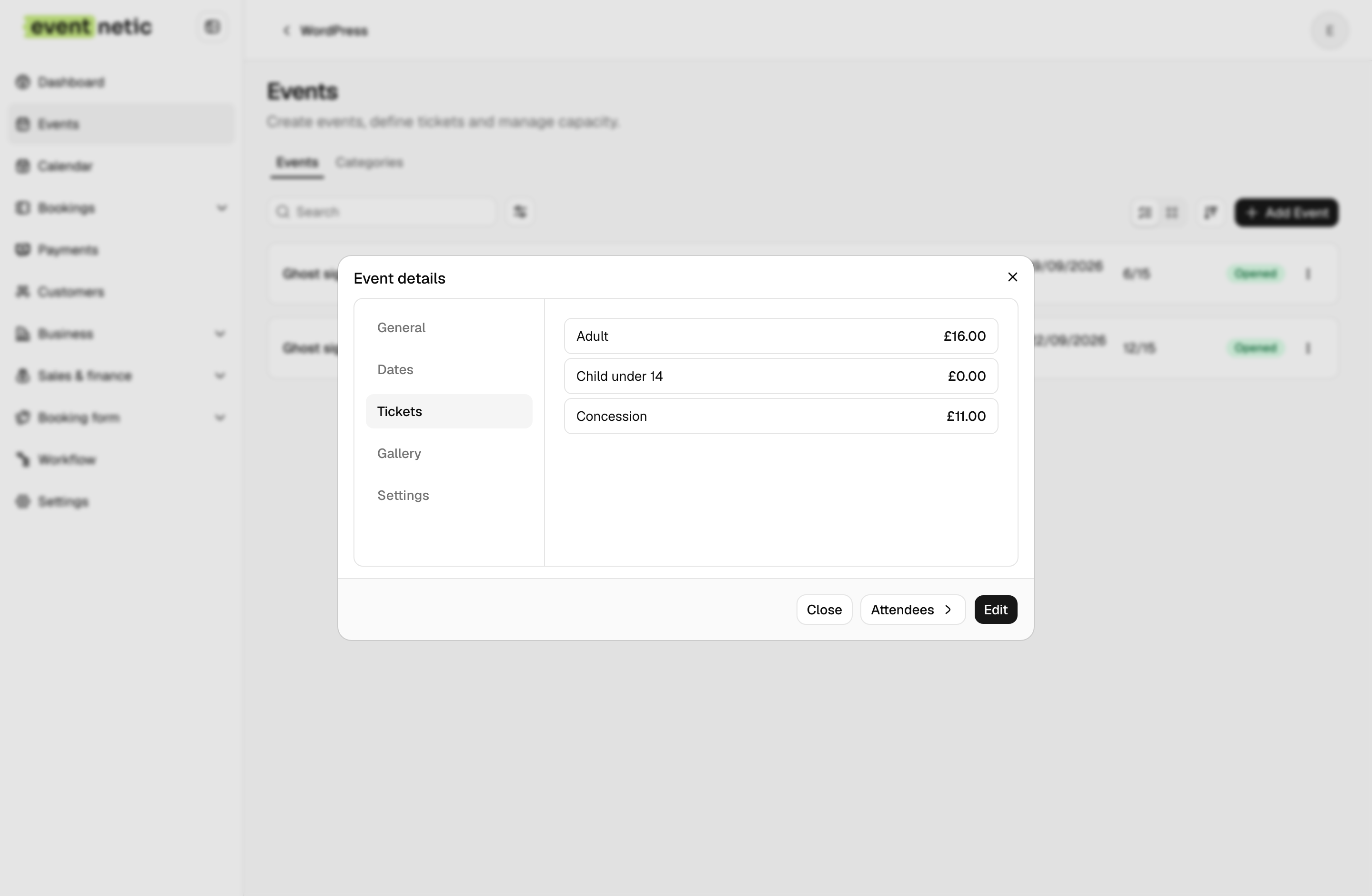
Adult £16, concession £11, under-14s free.
All three draw from the same fifteen. That is the setting to get right, and it is the one people get wrong on a free ticket, because free feels like it should not count. It counts. A family of two adults and three children is five people standing in the street. If the free children do not take places, you arrive to find twenty people waiting for a guide who prepared for fifteen.
The ticket description says it out loud: Free, but book a place. Fifteen is fifteen whatever their age.
The concession is the other decision worth thinking about. £11 against £16 is not charity, it is filling a walk that would otherwise run with nine people on it. A guide costs the same either way, so the fifth concession ticket on a quiet Tuesday is £11 of pure margin.
Step 4: twenty dates, most of them empty
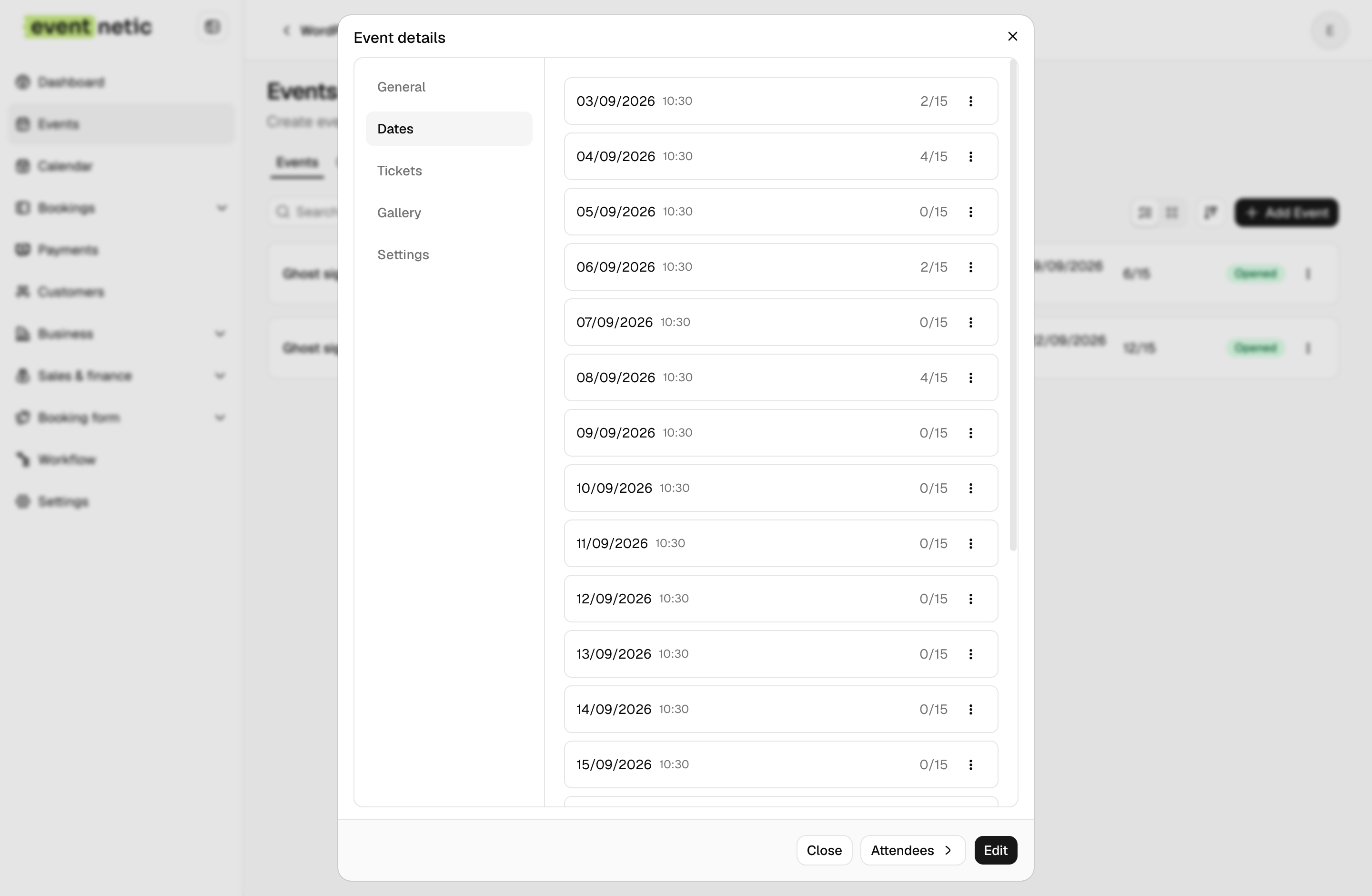
This is the honest picture of a daily tour and we have not tidied it up.
Four dates have people on them. The rest are zero. That is normal. You put three weeks on sale because a visitor booking on Tuesday for Thursday needs Thursday to exist, and most of those Thursdays will not sell.
One event carries all twenty dates. Not twenty events. This is the same model as the yoga studio in the recurring post. One description, one price list, one photograph. A date is a thing somebody buys rather than a thing you maintain. Change the price and it changes on all twenty.
The golden-hour walk is a separate event, because it runs Fridays and Saturdays only and its dates are a different set. Same rule as everywhere else in this product. Different capacity or a different set of dates means a different event.
Step 5: booking closes an hour before
The morning walk stops taking bookings sixty minutes before it starts.
Not because the system cannot cope, but because the guide is already walking to the arch. Somebody who books at 10:25 for a 10:30 start gets a confirmation email they will not read. They are not there when the group leaves. You have sold something you could not deliver.
An hour is the setting for a tour that meets outdoors. Our workshop demo uses five days for the same field, because leather has to be cut before anybody arrives. The number encodes how long it takes you to get ready, and it is worth setting deliberately rather than leaving at zero.
What we do not do
No OTA distribution. Said already, and it is the big one for this business specifically. We sell from your site. We do not put you in front of anybody who is not already there.
Nothing knows about the weather. A washed-out Thursday is cancelled by a person, from the admin, and the refunds are a decision rather than a rule. We have no forecast integration and no plans for one.
No guide app. There is no phone screen showing today's list with a tick next to each name. You can see the attendees for a date in the admin on your phone browser, which works, and is not the same thing.
No pay-what-you-want. Free walking tours running on tips are a large part of this industry and we cannot model them. A ticket has a price, and zero is a price, but there is nowhere for somebody to decide the amount.
Go and book a walk
Ghost Signs Walks is live with three weeks of mornings, the golden-hour walk on Fridays and Saturdays, and the meeting point written the way a person would say it.
Open the walking tour demo and book one adult and two under-14s. Then open the Dates tab in the admin. That morning has gone from two of fifteen to five, and two of the three people who took a place paid nothing.
One thing the demo will show you that we would rather it did not: a visitor never sees how many places are left. The number lives in the admin. On a fifteen-place walk that is a missed nudge, and it is on the list.
Every screenshot is the running demo, not a mock-up. Prices, capacity and the date list are read from it. Bókun's and Rezdy's fees are quoted from their own pricing pages, opened and read on 2 September 2026, and converted at 0.7415. Viator and GetYourGuide are described rather than quoted because neither publishes a supplier rate we could open.


