Music venue ticketing in WordPress: who pays the booking fee
2 Sep 2026 · Eventnetic Admin

A gig is a room with no seats in it. Nobody picks a spot, nobody sits where the ticket says, and the only number that matters is how many bodies the fire officer allows through the door.
That makes a music venue the simplest thing to model on this blog so far. No seating chart. No timed slots. One number and a door.
Which is exactly why the interesting part of a venue's setup is not the capacity. It is the booking fee, and who ends up paying it.
This is how to build it in WordPress. The Coalyard is our demo: a 250-capacity room under a railway arch in Manchester, three gigs on sale, one of them sold out. Every screenshot below is that site running.
What a gig ticket costs on a ticketing platform
Live music works differently from every other business we have written about, and the difference is worth understanding before any of the numbers mean anything.
In a cinema or a museum, the platform bills the organiser. In live music, the platform bills the fan.
Skiddle publishes the rate: 10% of the ticket face value plus 27p, with a minimum booking fee of £1. Their own help centre gives the worked example: a £20 ticket carries a £2.27 fee, so the fan pays £22.27. The promoter is told this costs them nothing, and in the narrow sense that is true. The money comes out of the customer, not the settlement.
DICE is the other name every UK venue will raise, and we have nothing to quote. They publish no rate card we could find, and their help pages would not open for us at all. Their fee is folded into the displayed price rather than added at checkout, which fans like and which also means nobody outside the deal knows the number. We are not going to invent one.
Eventbrite's UK organiser rate is 3.7% plus a fixed fee per ticket, and 2.9% payment processing per order, which by default is also passed to the attendee.
So the honest framing is not "you save money". It is: that fee exists either way, and right now it is not yours. Here is what it looks like on the three nights in our demo, against Stripe's published UK card rate of 1.5% plus 20p.
| Ticket | Face value | Skiddle fee | Stripe on your own site | Difference |
|---|---|---|---|---|
Hardy Trio, sold out | £18.00 | £2.07 (11.5%) | £0.47 (2.6%) | £1.60 |
Wovenhand Sunday | £14.00 | £1.67 (11.9%) | £0.41 (2.9%) | £1.26 |
New band night | £6.00 | £1.00 (16.7%) | £0.29 (4.8%) | £0.71 |
Look at the bottom row. The £1 minimum means a cheap ticket is where the percentage gets ugly. On a £6 door price for four local bands, the fee is a sixth of the ticket. That is the night you run at a loss to find the next headliner, and it is the night the fee hurts most.
On the sold-out night alone, 240 tickets at £18 carry £496.80 in booking fees. The same 240 cards through Stripe cost £112.80. Even in the worst case, where every single card is a non-EEA international one at Stripe's 3.15% plus 20p, you are at £184.08 and still £312 better off.
Run two gigs a week for a year, sell 150 on an average night at an average £13, and that is 15,600 tickets. The gap is a little over £18,000. A licence is £99.
You can hand every penny of that back to your audience by dropping your prices, or you can keep it. That is now a decision you get to make, which is the actual thing being bought here.
The break-even is 85 tickets. Half of one Friday.
Step 1: capacity is a number
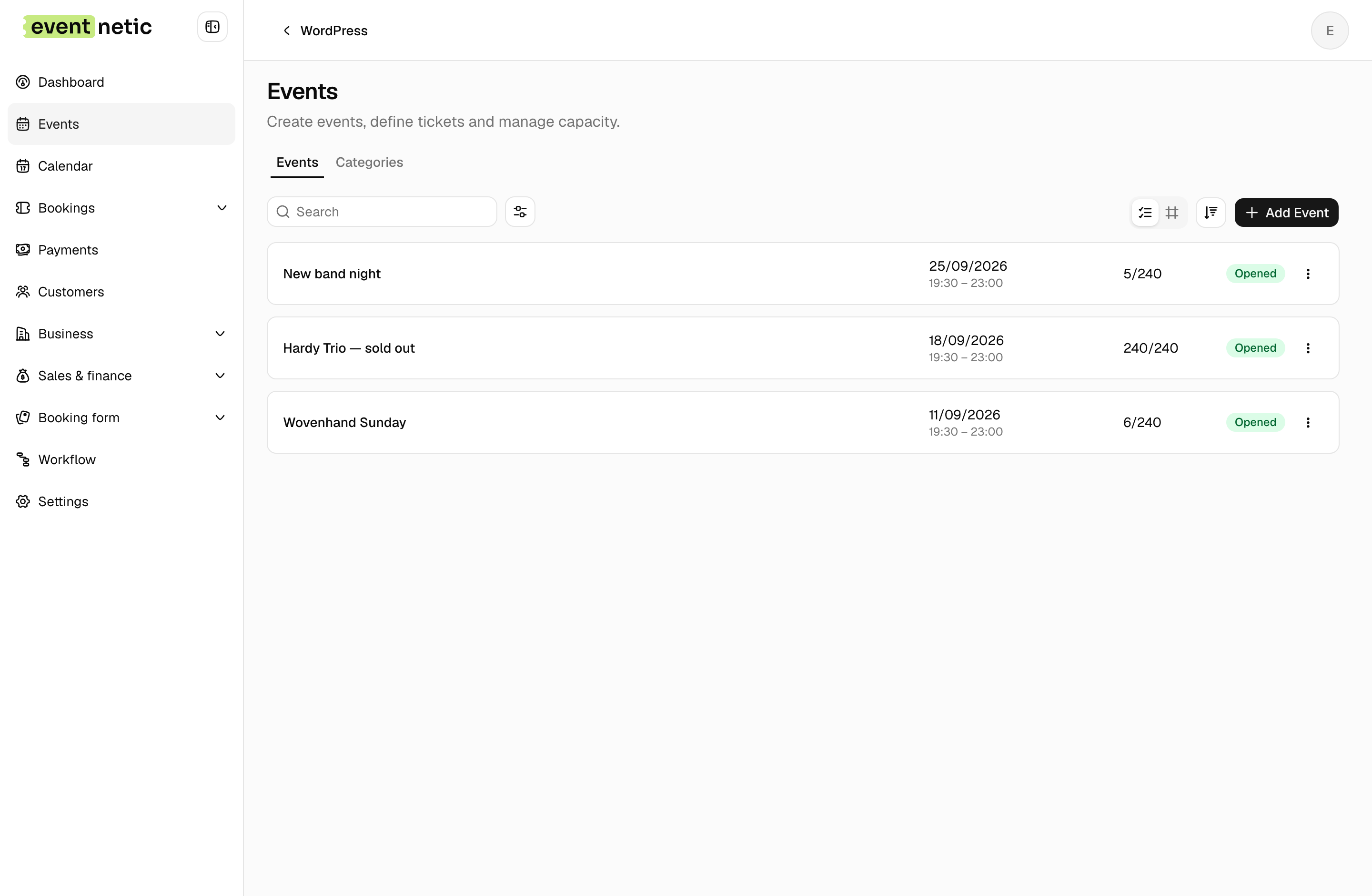
There is no room layout to draw here. You set one number on the event and you are done.
The Coalyard holds 250 standing. The events above say 240, and the missing ten are deliberate. More on them in a moment.
If you have read the seating post, this is the opposite case. A theatre needs a chart because the ticket has to name a seat. A venue with a floor and a bar does not, and forcing one on it would be busywork that also breaks the moment somebody stands somewhere else.
Step 2: advance is cheaper than the door, on purpose
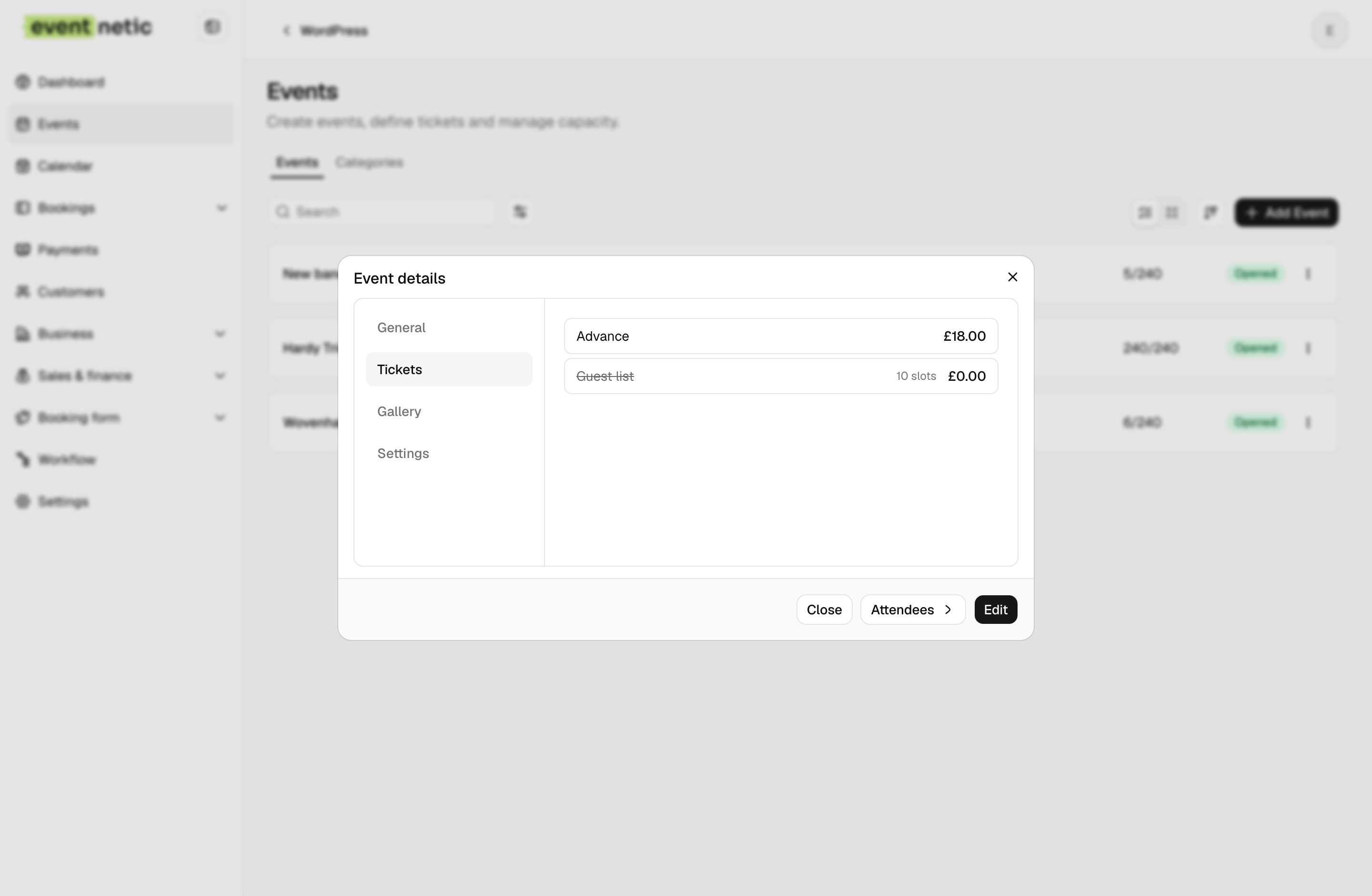
£18 advance, £22 on the door. That gap is not greed and it is not a discount. It is information.
A venue that sells 200 in advance knows on the Wednesday how many bar staff to roster for the Friday. A venue that sells nothing in advance finds out at 8pm. The four quid is what you pay people for telling you early.
The ticket description says so out loud: £22 on the door if any are left. They usually are not. Write that yourself. A price difference nobody explains reads as a rip-off, and the same difference explained reads as a reason to buy now.
Step 3: the ten you hold back
Every gig has a guest list. The band, the support, whoever is doing the door photos, someone's cousin.
In the screenshot above the Guest list ticket is struck through, holding ten slots at £0.00. Struck through means switched off, and that is doing three jobs at once.
It keeps those ten out of what the public can buy, so the counter reads 240 rather than 250. It hides the row from the booking page, because a free ticket anybody can add to their basket is not a guest list, it is a hole in the wall. And it holds the number visibly, so the ten are a decision somebody made rather than ten seats that quietly went missing.
Here is the part we are not going to dress up. Switching a ticket off also means nobody can be booked onto it, including you from the admin. The names still live on a door list. There is no ticket type in this product that only staff can issue, and if that is the feature you need, we do not have it yet.
The mechanism above is what we would actually do in a real venue, and it is worth knowing that it is a workaround rather than a feature.
Step 4: six per order, and why not more
Both tickets cap at six per order. That is not a technical limit, it is a touting one.
Six is roughly the largest group that turns up together at a 250-cap room. Above that you are mostly selling to people who intend to resell, and a cap is the cheapest tool you have against it. It costs you nothing, because the party of eight simply places two orders and the tout has to make eight accounts.
Step 5: the night that sold out
The Hardy Trio night is at 240 of 240. Not a label on the event, an actual full room.

This is the screen the whole scenario exists to show. When the last place goes, the ticket picker is replaced by a waiting list, and the person who arrived too late leaves you their email instead of leaving.
That is worth more than the ticket they did not get. Returns happen on every sold-out night, and a queue means the returns go to somebody who already said yes rather than to whoever happens to refresh the page. It also tells you something you can act on. Nine parties wanting nineteen places, on a room that holds 250, is the band saying out loud that they should have been booked somewhere bigger.
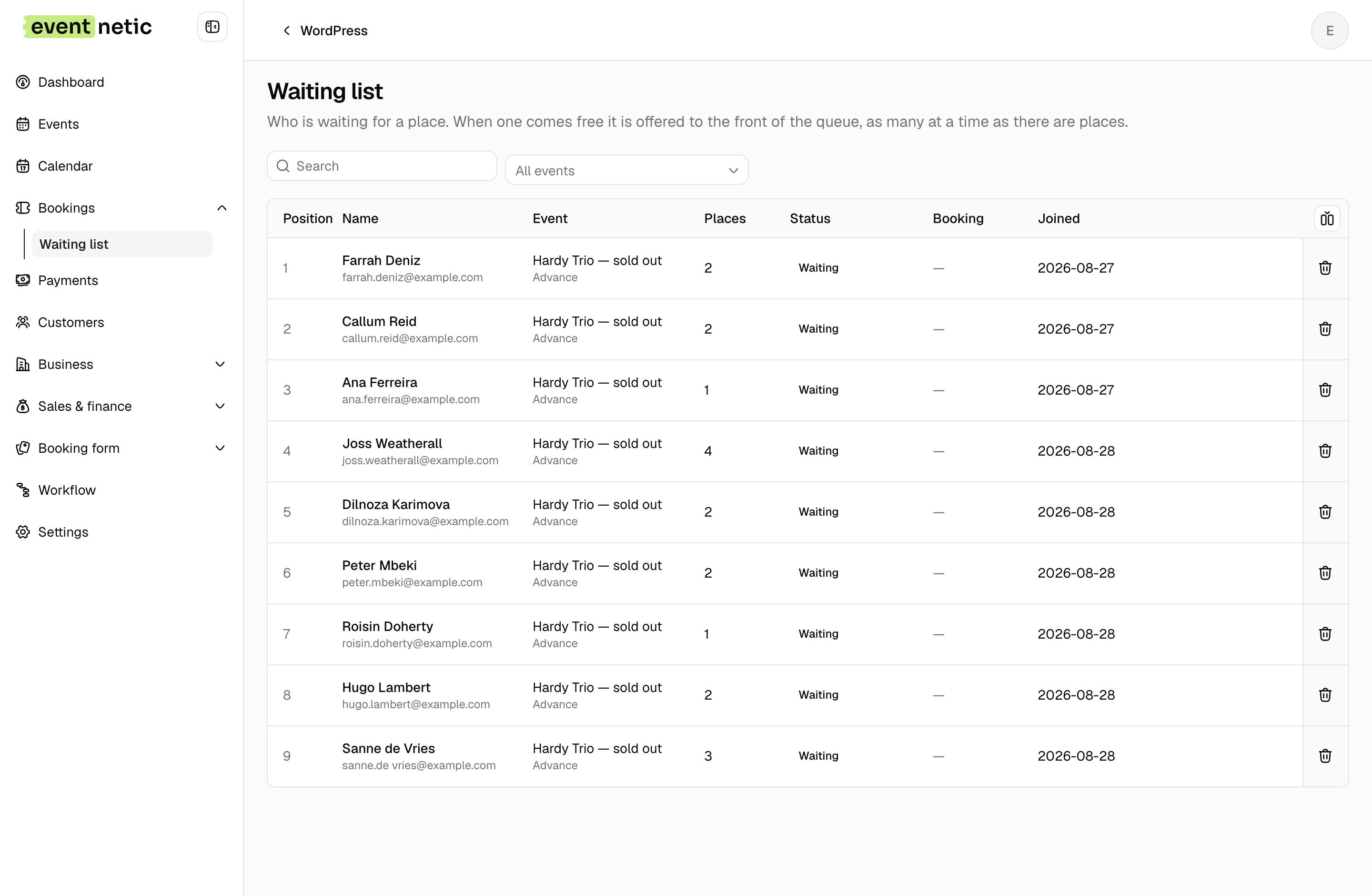
The admin side is a list you can read and work through. Nothing releases a place automatically, which we think is right for a gig. A returned ticket at a venue is usually a phone call, not a transaction.
What we do not do
Four gaps worth knowing before you move a venue onto this.
No staff-only tickets. Covered above. A guest list is held rather than issued.
No door scanning app. Bookings can be marked as checked in from the admin, but there is no phone app that reads a QR code at the door. For 250 people on a Friday that matters, and we would not pretend otherwise.
No resale or ticket transfer. A fan who cannot come has no way to pass their ticket to a friend inside the system. DICE built their whole reputation on solving exactly this, and they solved it properly.
No discovery. This is the big one, and it is not a bug we intend to fix. Skiddle and DICE are places people browse when they do not know what they want on Saturday. Your own website is not. Some of your tickets come from people who found the gig on a platform rather than from you. Move everything in-house and you lose those sales. The fee was buying something real.
The venues this suits are the ones with an audience that already follows them. A mailing list, an Instagram, a regular crowd. If that is you, the platform is charging your own audience a fee to reach you.
Go and look at the sold-out one
The Coalyard is live. Three gigs, real prices, 85 orders on the Hardy Trio night filling the room to the last place.
Open the live music demo and go to the sold-out night first. There is nothing to buy, which is the point.
Every screenshot is the running demo, not a mock-up. Prices, capacities and the waiting list are read from it. Platform fees are quoted from Skiddle's, Eventbrite's and Stripe's own published pages, opened and read on 2 September 2026. All three vary by country and by deal. DICE is described rather than quoted because we could not open a page of theirs to cite.


